


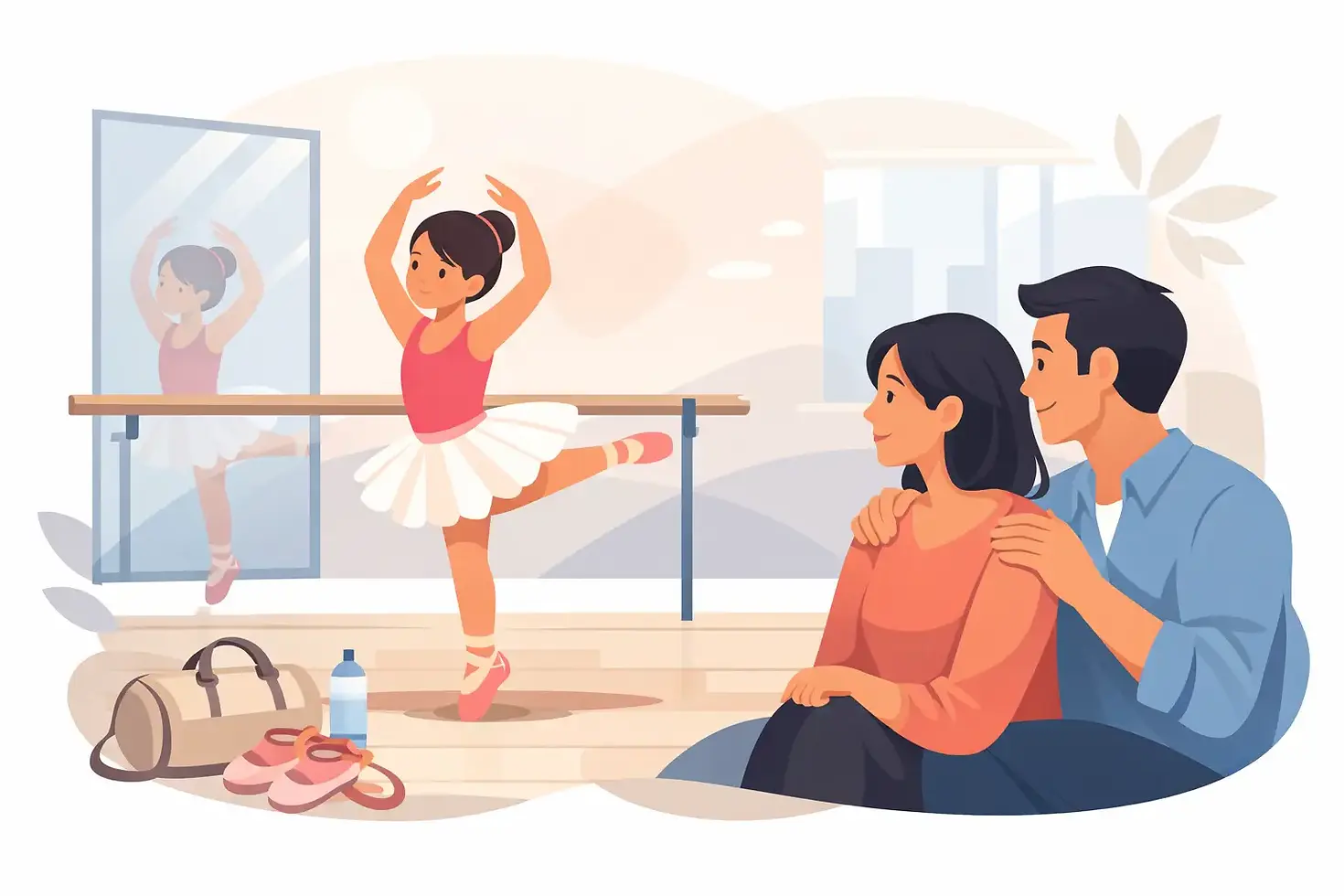
How to Support Your Child in Dance With Confidence

A child may come home from dance class proudly showing one small step, or quietly say, “I don’t think I can do it.” Both moments matter. Knowing how to support your child in dance is not about turning your home into a rehearsal studio or expecting fast progress. It is about giving them the security, routine, and encouragement that let their confidence grow alongside their skills.
For toddlers, preschoolers, and young children, dance is often one of their first experiences learning in a group without a parent beside them. They are practicing listening, taking turns, moving with purpose, and expressing themselves in a new way. Your calm support before and after class can make a meaningful difference.
Support the Experience, Not Just the Performance
It is natural to feel excited when your child has a recital, learns a new routine, or receives positive feedback from their teacher. Celebrating those moments is wonderful. But young dancers benefit most when parents notice the effort behind the outcome.
Rather than asking, “Did you get all the steps right?” try questions such as, “What was your favorite part of class?” or “Was there a step that felt easier today?” These questions tell your child that dance is a place to learn, enjoy, and try again, not a test they need to pass.
A child who is praised only for being naturally talented may start to worry about making mistakes. A child who hears, “I saw how patiently you practiced,” learns that effort has value. This mindset is especially helpful in ballet and foundational technique, where progress often comes through small, repeated improvements in balance, posture, coordination, and control.
Let Them Have Their Own Feelings
Not every class will end with excitement. A young child may feel shy, tired, frustrated, or disappointed when a move is difficult. Resist the urge to immediately talk them out of those feelings. A simple response like, “That sounds like it was hard today. I’m proud of you for staying in class,” helps them feel understood.
Sometimes a difficult day is simply a difficult day. Other times, it may signal that your child needs more rest, a clearer routine before class, or a conversation with their instructor. The goal is not to remove every challenge. It is to help your child see that challenges can be managed with support.
How to Support Your Child in Dance Before Class
The hours before dance class can shape how ready your child feels to participate. Young children do best with predictable routines, particularly after a full day at preschool or school.
Start with practical comfort. Make sure they have had a light snack and water, enough time to use the restroom, and clothing that allows them to move freely. If their class has a uniform or specific shoes, prepare these together the night before when possible. This avoids a rushed search for a missing ballet slipper just as it is time to leave.
For children who are new to class, it can help to describe what will happen in simple terms: “We’ll arrive, you’ll say hello to your teacher, and then you’ll dance with your class.” Avoid making big promises, such as saying they will love every minute. A more reassuring message is, “Your teacher will help you, and I’ll be here when class ends.”
Arriving a few minutes early can also make a difference. It gives your child time to settle in, recognize the space, and transition from home or school into class. For a child who is naturally cautious, that gentle transition can be far more helpful than repeated encouragement to “be brave.”
Create a Healthy Rhythm at Home
You do not need daily formal practice for dance to become a positive part of family life. In fact, pushing too much practice at a very young age can make a joyful activity feel like pressure. What matters more is creating a home rhythm that respects your child’s commitment while leaving room for play, rest, and other interests.
If the teacher suggests simple practice, keep it short and light. Five or ten minutes of listening to music, pointing and flexing feet, or remembering a class sequence may be enough for a beginner. Stop while your child is still feeling successful rather than continuing until they are tired or upset.
Dance also benefits from the basics of a well-balanced childhood. Regular sleep supports concentration and mood. Nutritious meals support energy. Free play develops imagination and body awareness. Children do not need to be busy every afternoon to become confident dancers. They need enough space to recover and stay curious.
Be Careful With Comparisons
In a class of young dancers, children develop at different speeds. One child may quickly remember choreography, while another may have strong musicality or a beautiful ability to focus. Height, personality, previous exposure to movement, and developmental stage can all affect what progress looks like.
Comparisons can make a child focus on what they cannot yet do. Instead of saying, “Look how high her leg goes,” bring the focus back to your own child: “Your balance looked steadier today,” or “You remembered to listen for the music.” This helps them build an internal sense of progress.
It is also wise to keep adult conversations about casting, technique, or other children away from young ears. Children often understand more than we expect, and they deserve to feel that dance is a safe place to learn without being measured against their classmates.
Build a Respectful Partnership With the Teacher
A qualified children’s dance instructor sees your child in a setting that is different from home. They can notice how your child joins group activities, follows directions, responds to music, and gains confidence over time. Their perspective can be valuable, especially when your child is too young to explain much about class.
Keep communication warm and focused. If you have a concern, share it privately and clearly. For example, you might mention that your child has been nervous at drop-off, is recovering from an illness, or has said a particular movement feels uncomfortable. This gives the teacher useful information without putting your child on the spot.
At the same time, trust the classroom structure. Teachers often use songs, imaginative prompts, and repeated routines because these methods are developmentally appropriate. What may look like a simple game is often helping children practice rhythm, coordination, spatial awareness, or classroom skills.
Small class sizes and experienced instructors are especially valuable for early learners because children receive more individual guidance. At C Dance Academy, this nurturing approach helps young dancers feel seen while still learning to participate as part of a group.
Make Performances Feel Safe and Special
Recitals and performances can be exciting family milestones, but they can also be overwhelming. Bright lights, costumes, an unfamiliar stage, and a large audience are a lot for a young child to manage. Your role is to keep the event in perspective.
Before the day, speak positively but calmly. Let your child know that the purpose is to share what they have been learning, not to be perfect. Remind them that it is okay if they forget a step, look for their teacher, or need a moment to settle. Many young children do, and that is part of the learning process.
On performance day, avoid adding unnecessary pressure. Keep meals familiar, allow extra travel time, and choose encouraging words over last-minute corrections. A simple, “Have fun and listen to your teacher,” is usually more useful than reviewing every detail of the routine.
Afterward, celebrate the courage it took to participate. Whether your child danced boldly, stood very still, or burst into tears before going onstage, they have had a meaningful experience. Tell them you were happy to watch them. The memory of being accepted matters more than applause.
Know When to Encourage and When to Pause
There is a difference between normal nerves and ongoing distress. Many children need several classes to feel comfortable, particularly if they are starting at age two or three. Gentle consistency often helps them build trust in the teacher, the routine, and themselves.
However, if your child regularly becomes highly distressed, complains of pain, or seems withdrawn for several weeks, pause and look more closely. Speak with the instructor and consider what may be contributing. It could be a schedule issue, fatigue, an adjustment period, or a class that is not the right fit at this moment.
Supporting your child does not mean insisting that they continue no matter what. It means helping them develop resilience while also respecting their wellbeing. Sometimes the best next step is to continue with reassurance. Sometimes it is to reduce commitments, try a different class level, or return when they are more ready.
Your child will remember far more than the steps they learned. They will remember arriving to a familiar smile, being allowed to make mistakes, and seeing you proud of the person they are becoming. Offer that steady presence, and dance can become a place where they feel capable, joyful, and wonderfully themselves.


Comments