


A Parent’s Guide to Kids Dance Progression

One child starts by twirling in the living room. Another hides behind a parent’s leg for the first three classes, then suddenly joins in. Both can be on a healthy path - and that is exactly why a guide to kids dance progression matters. For young children, progress in dance is not only about steps and performances. It is also about confidence, body awareness, listening, coordination, and learning to enjoy movement in a supportive environment.
Parents often ask the same question in different ways: How do I know if my child is progressing? The reassuring answer is that dance development in children is rarely a straight line. Some children show musicality early. Some need more time to feel secure in class. Some love structure, while others bloom through imaginative movement first. Good progression respects age, readiness, and the child in front of you.
What kids dance progression really looks like
When adults think of dance progress, they often picture harder skills, better posture, and more polished choreography. Those things do matter, but in early childhood dance, progress starts much earlier than that. A toddler who can separate from a parent more comfortably, follow a simple rhythm, and move safely with a group is building a real foundation.
That is why strong early programs do not rush technical training before a child is ready. Instead, they build the pieces that make future technique possible. Balance, coordination, attention span, spatial awareness, and classroom habits all support dance learning later on. Without those basics, faster progression can actually become frustrating.
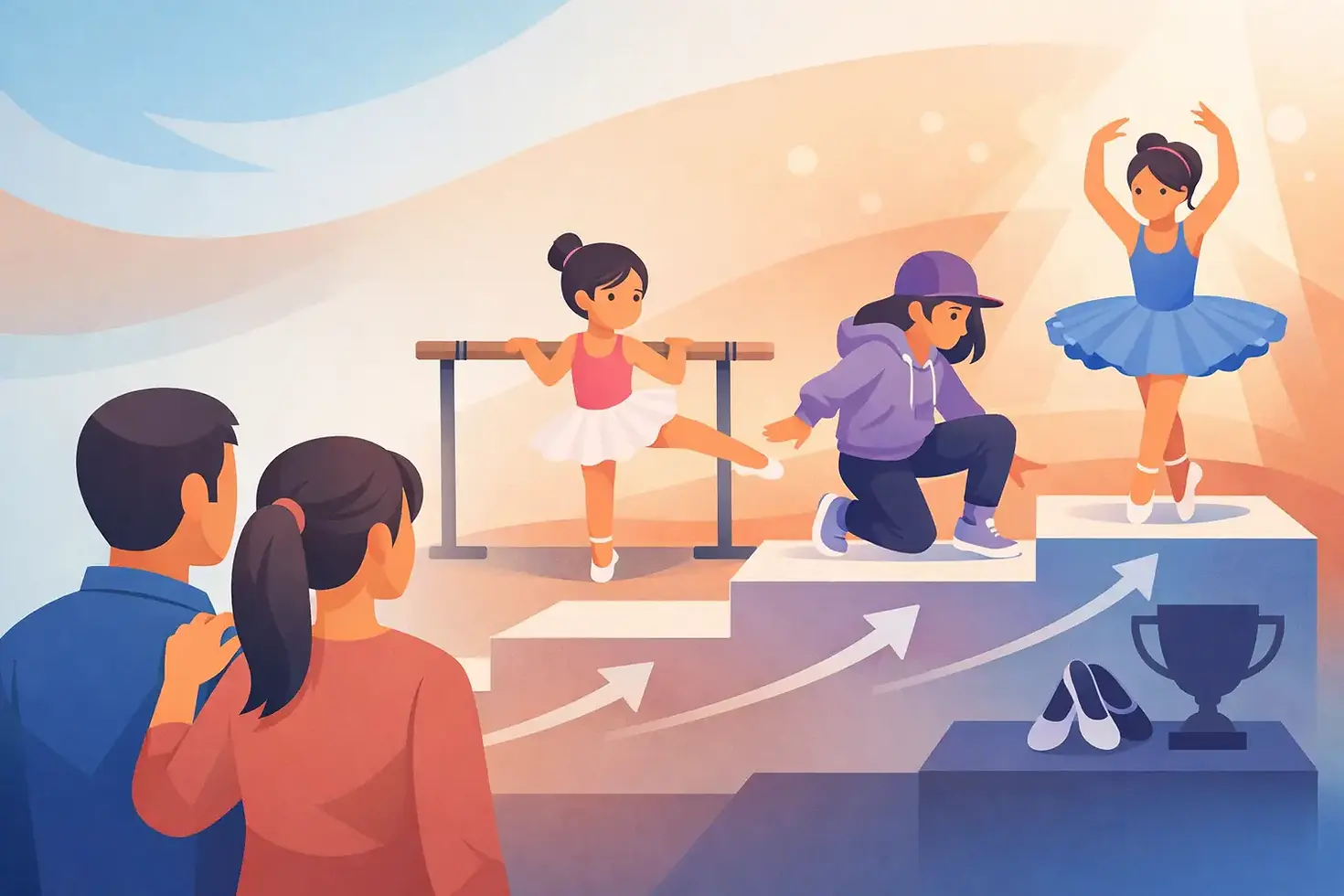
For parents, it helps to think of dance progression in layers. The first layer is comfort and participation. The second is movement quality and control. The third is technique, memory, and expression. Children move through these layers at different speeds, and that is normal.
A simple guide to kids dance progression by age
Ages 2.5 to 4: comfort, rhythm, and joyful movement
At this stage, the goal is not perfection. It is introduction. Young dancers are learning how to be in a class, how to listen to an instructor, and how to connect music with movement. They may practice tiptoeing, jumping, marching, stretching, and simple ballet or creative movement patterns.
Progress here often looks subtle from the outside, but it is significant. A child who begins by wandering may later stay with the group for most of the class. A child who watches quietly may start copying arm movements or remembering a warm-up routine. These are meaningful wins.
This is also the age when imagination matters. Children learn best when movement is playful and visual. Pretending to be butterflies, floating scarves, and moving through stories are not distractions from learning. They are often the best route into it.
Ages 4 to 6: coordination, routine, and early technique
As children grow, they can usually follow longer instructions and repeat movement patterns more consistently. This is when early ballet structure, basic jazz movement, and foundational technique can become more defined. They may begin to understand class format, take turns more patiently, and hold positions with better control.
Parents may notice stronger posture, improved balance, and clearer musical timing. They may also see emotional growth. Children often become more willing to perform in front of others, more resilient when they make mistakes, and more proud of working toward a goal.
At this stage, progression still should not feel harsh or overly rigid. Children benefit from structure, but they also need warmth and encouragement. The best classes challenge them while protecting their love of dance.
Ages 6 and up: technique, discipline, and artistic growth
Once a child has a solid early foundation, more formal technique can be introduced with greater success. They are often ready to remember longer combinations, refine alignment, and develop more control in turns, jumps, and transitions. Instructors can begin correcting details more specifically because the child has enough body awareness to apply them.
This is also when consistency starts to matter more. A child who attends regularly usually progresses more steadily than a child who joins only occasionally. Even so, every child develops differently. Some may advance technically very quickly, while others stand out first in musicality, expression, or focus.
Signs your child is progressing, even if it is not obvious
Parents sometimes worry when their child is not doing the biggest jumps or the neatest positions in class. But visible skill is only one part of progress. In children’s dance education, some of the most important changes happen quietly.
A progressing child may enter class more independently, respond faster to cues, and remember classroom routines. They may become more aware of personal space and move with better control. They may also show growth outside the studio by standing taller, following directions more confidently, or expressing themselves more freely.
There are weeks when progress seems to stall. That can happen after a growth spurt, a school transition, or even a period of tiredness. Children are not machines, and development does not move on a perfect schedule. What matters is the overall direction over time, not one off day or one shy class.
What can slow healthy dance progression
One common issue is starting with expectations that are too advanced for a child’s age. When a class focuses heavily on polished performance before the child has basic coordination and confidence, the result can be stress instead of growth. Children may begin to feel they are failing when they are actually just being asked to do too much too soon.
Another issue is inconsistent attendance. Young children thrive on repetition. Repeating the same movement ideas, routines, and class rhythms helps them feel secure and capable. Missing many classes can make it harder for them to build that comfort.
The teaching environment matters too. Large classes, rushed instruction, or teachers without experience in early childhood dance can affect progression. Young dancers need patient guidance, age-appropriate expectations, and enough individual attention to feel seen.
How to support your child at home without pressure
Parents do not need to become dance teachers at home. In fact, too much correction outside class can take the joy out of learning. The most helpful support is usually simple and encouraging.
Play music and let your child move freely. Ask what they enjoyed in class instead of asking whether they were the best. Notice effort: how nicely they listened, how bravely they joined in, or how carefully they remembered a step. These kinds of comments build confidence in a healthy way.
Routine also helps. Arriving calm, dressed comfortably, and not rushed sets the tone for a better class experience. If your child is very young, regular attendance matters more than long practice sessions at home.
Choosing the right class for your child’s stage
The right class can make progression feel natural. The wrong one can make dance feel confusing or discouraging. That is why class placement should be based on more than age alone. Temperament, previous experience, and readiness all matter.
A shy three-year-old may still thrive beautifully in a gentle beginner class with predictable structure. A confident five-year-old may be ready for more technical instruction if the teaching remains age-appropriate. There is no prize for moving children up too quickly. Strong foundations almost always serve them better in the long run.
This is where thoughtful children’s programs stand apart. At C Dance Academy, the focus on early childhood ballet education and foundational training reflects this kind of progression-first approach. For families in Petaling Jaya or Bandar Utama, that can be especially valuable when choosing a first dance home for a young child.
When should parents be concerned?
Most variation in dance development is completely normal. Still, there are moments when it is worth asking questions. If a child consistently dreads class, seems overwhelmed every week, or receives expectations that feel far beyond their age, the fit may not be right. Sometimes the issue is not dance itself, but the class level, teaching style, or timing.
It is also reasonable to check in if your child wants to dance but never seems to settle, engage, or feel successful after a fair adjustment period. A good studio should be able to talk honestly with parents about readiness, placement, and next steps without making anyone feel pressured.
A child’s dance journey should feel guided, not forced. The best progression combines structure with patience, correction with encouragement, and skill-building with joy. When that balance is in place, children do more than learn steps. They grow into themselves a little more each week, and that is a beautiful kind of progress to watch.


Comments